
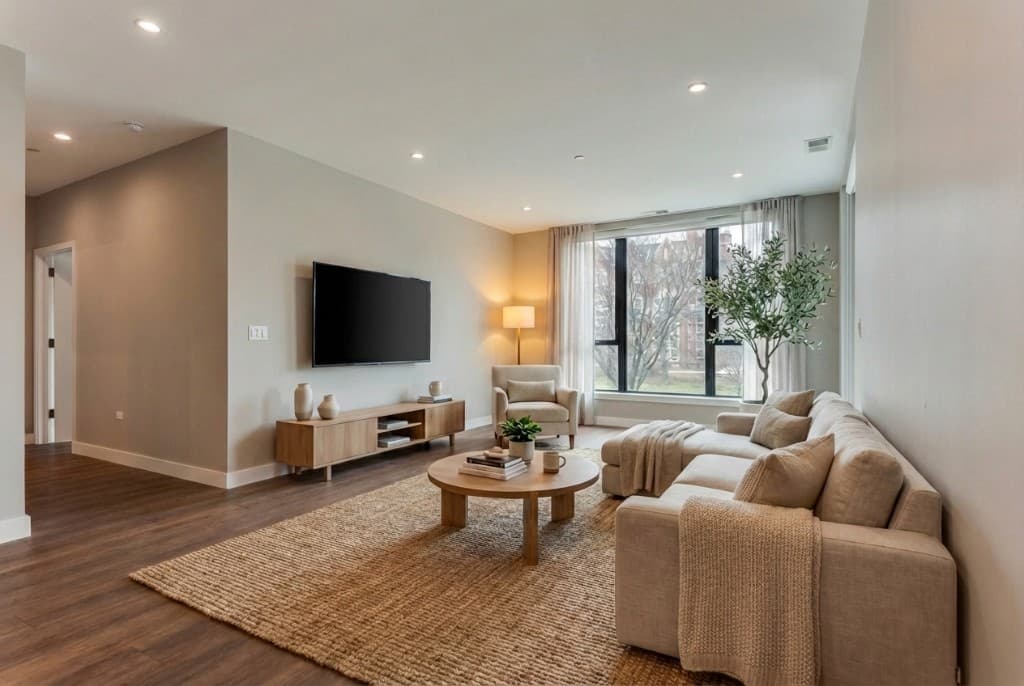
Every agent listing a vacant or awkwardly furnished property eventually has to answer the staging question. Should you bring in a staging company to fill the rooms with rental furniture? Or use AI to add furniture to the photos digitally, at a fraction of the cost? The honest answer is: it depends on the listing — but most of the time, it depends less than the staging industry would like you to believe.
This guide walks through the real differences between virtual staging and traditional physical staging: what each one actually costs, how long each one takes, how convincing each one looks to a buyer, and which one makes sense for your specific listing. We'll also cover the scenarios where combining both is the smarter play.
What Each Approach Actually Is
Traditional Physical Staging
A staging company assesses the property, then delivers and installs real furniture, rugs, art, and accessories chosen to appeal to the target buyer demographic. The furniture stays in the home for the duration of the listing (or a rental period), and everything is removed once the property sells or the listing ends. It's a physical service — trucks, movers, and a team on-site.
Virtual (AI) Staging
Virtual staging adds furniture and décor to a photo of the empty (or occupied) room using AI, rather than physically installing anything. You take or receive photos of the space, upload them to a platform like Rendershop, and get back photorealistic staged versions of those same rooms — typically within minutes. Nothing physical changes about the property; only the listing photos change.
Cost: The Gap Is Bigger Than Most Agents Expect
This is where the comparison is least ambiguous. Traditional staging is a recurring physical-goods rental service; virtual staging is a one-time digital service.
- Traditional staging setup: $1,500–$4,000 for a 2,000 sq ft home, plus $500–$1,500/month while listed
- Traditional staging, 2-month listing total: Typically $2,500–$7,000+
- Virtual staging, per room: A few dollars per image
- Virtual staging, full listing (6–10 rooms): $15–$80 total
At the low end, that's roughly a 50:1 cost difference in favor of virtual staging. Even at the high end of traditional staging pricing versus a generous virtual staging budget, the gap rarely closes below 20:1.
Speed: Days vs Minutes
Traditional staging requires scheduling a consultation, sourcing furniture that fits the space, coordinating a delivery crew, and installing everything — typically a 3–10 day process before you can even photograph the property. If a piece doesn't work once it's in the room, swapping it means another delivery visit.
Virtual staging works from photos you already have. Turnaround is same-day, often within minutes per image, and if a style doesn't land you simply regenerate it with a different prompt — no truck, no second visit, no added cost worth mentioning. For listings where the seller wants to go live this week, virtual staging is frequently the only option that fits the timeline.
Realism and Buyer Perception
Traditional staging has one clear advantage: what buyers see in the photos is exactly what they'll see at the showing. There's no gap between the marketing and the walkthrough. Modern AI virtual staging has closed the visual quality gap substantially — photorealistic lighting, shadows, and proportion are now standard on platforms built for real estate — but the furniture in the photos won't physically be there when a buyer walks in.
This makes disclosure important. Reasonable practice is to label virtually staged photos clearly ("virtually staged for illustrative purposes") and, where possible, include at least one true empty-room photo in the gallery. Buyers who arrive at a showing already knowing the furniture was digital rarely feel misled; buyers who assumed otherwise sometimes do. For a full breakdown of state-by-state rules, see our guide to virtual staging disclosure requirements.
Flexibility: Occupied Homes and Multiple Styles
Physical staging requires a vacant space — you can't deliver rental furniture into a home the sellers are still living in. Virtual staging has no such restriction. You can photograph an occupied home exactly as it is and use AI to digitally remove clutter or existing furniture and replace it with a more market-ready look, without asking the sellers to move out early or store their belongings.
Virtual staging also makes it cheap to try more than one look. With physical staging you install one style and live with it for the listing period. With AI, producing the same living room in a warm traditional style, a Scandinavian-minimal style, and a coastal-casual style takes an afternoon, letting you test which version gets more clicks or match the style to the likely buyer profile for that neighborhood.
Side-by-Side Comparison
| Factor | Virtual Staging | Traditional Staging |
|---|---|---|
| Cost (6–8 rooms) | $15–$80 | $2,500–$7,000+ |
| Turnaround | Minutes to same day | 3–10 days |
| Works in occupied homes | Yes | No — needs vacant space |
| Multiple style variations | Unlimited, low cost | One style; costly to change |
| Matches the in-person showing | No — photos only | Yes — physically present |
| Best for | Most vacant & occupied listings, fast timelines, budget-conscious sellers | Luxury listings, competitive open houses, sellers who want furniture on-site |
| Disclosure requirement | Recommended / required in some states | Not applicable — furniture is real |
When Traditional Staging Still Wins
For listings above roughly $1.5M–$2M, or in markets where in-person open houses drive most offers, physical staging still has an edge. Buyers touring multiple luxury properties in a day respond to the tactile, in-room experience that photos — real or AI — can't fully replicate. In these cases the strongest approach is often both: virtual staging for the digital marketing photos that go live immediately, and physical staging installed in time for showings and the open house.
A Simple Decision Framework
- Under $1.5M and vacant or occupied: Use virtual staging by default. The cost and speed advantage is decisive, and buyer perception research doesn't show a meaningful sale-price gap at this tier.
- $1.5M+ or a competitive open-house market: Use virtual staging for launch photos immediately, then bring in physical staging ahead of the first showing weekend if budget allows.
- Seller can't vacate before listing: Virtual staging is close to the only realistic option — physical staging can't be installed around existing occupants and belongings.
- Tight listing timeline (this week): Virtual staging, every time. Physical staging's 3–10 day lead time simply doesn't fit.
Frequently Asked Questions
Is virtual staging as effective as traditional staging for selling a home?
For most price points, yes. Both approaches produce a similar lift in online engagement and days-on-market improvement over unstaged listings, since the core benefit — helping buyers visualize the space as furnished — is delivered by both. The difference shows up mainly at the luxury tier and at the in-person showing, where physical staging's tactile presence still has an edge.
Do I need to disclose that photos are virtually staged?
Best practice everywhere, and a legal requirement in a growing number of states, is to clearly label virtually staged photos in the listing (e.g., "virtually staged") and to include at least one unstaged photo so buyers know exactly what they're seeing. See our state-by-state guide to virtual staging disclosure rules for specifics.
Can I use virtual staging on a home that's still occupied by the sellers?
Yes — this is one of virtual staging's biggest advantages. You can photograph the space as it currently looks and use AI to digitally clear clutter or existing furniture and replace it with a more market-ready style, without asking sellers to move out or store belongings early.
How much does virtual staging cost compared to traditional staging?
Virtual staging typically runs $15–$80 for a full set of listing photos, versus $2,500–$7,000+ for traditional staging across a two-month listing period. The gap is usually 20:1 to 50:1 in favor of virtual staging.
Can I combine virtual and traditional staging on the same listing?
Yes, and for higher-end listings it's often the best approach: use virtual staging immediately for the listing launch and online marketing, then bring in physical staging ahead of in-person showings and the open house.
The Bottom Line
Virtual staging wins on cost, speed, and flexibility for the large majority of listings — it's not a compromise version of traditional staging, it's the better tool for most price points and timelines. Traditional staging still earns its place at the luxury tier and for in-person showings where buyers need the tactile, physical experience. The right call for most agents is to default to virtual staging on every listing and reserve traditional staging's higher cost and lead time for the properties where it genuinely moves the needle.
For more on the numbers behind the decision, see our guide to AI rendering ROI for real estate agents, or check our pricing page for current virtual staging rates.
See the Difference on Your Next Listing
Upload photos of an empty or occupied room and get photorealistic staged versions back in minutes. Try Rendershop free — no credit card required.
— The Rendershop Team