

The architectural profession is standing at a historic crossroads. For decades, the industry's technological leaps were defined by the transition from hand-drafting to CAD, and later, from 2D drawings to Building Information Modeling (BIM). Today, a new force is reshaping the studio: Artificial Intelligence.
But while the headlines are filled with AI-generated skyscrapers and surrealist interiors, a critical question remains for practitioners and firm leaders alike: How many architects are actually using AI in their daily workflows?
The answer is more complex than a single percentage. Depending on which study you read — and which region of the world you're in — the level of adoption varies from "experimental curiosity" to "foundational integration."
The Numbers: A Tale of Two Realities
To understand the state of AI in architecture, we must look at the data from the industry's most respected bodies. Interestingly, the reports from the American Institute of Architects (AIA) and the Royal Institute of British Architects (RIBA) paint two very different pictures.
The AIA Perspective: A Cautious Start
According to a landmark study published by the American Institute of Architects (AIA) in March 2025, the adoption of AI in the United States remains surprisingly low. The report found that only 6% of architects regularly use AI tools in their practice. While 8% of firm leaders reported some level of integration, the vast majority of the profession is still in a "wait-and-see" phase.
The AIA research highlights a significant split in sentiment:
- 78% of respondents expressed a desire to learn more about AI.
- Enthusiasm and wariness are almost evenly split among practitioners.
- The primary concerns cited include legal liability, copyright issues, and the potential loss of traditional design skills.
The RIBA and Chaos Perspective: Rapid Acceleration
In contrast, the Royal Institute of British Architects (RIBA) 2025 AI Report suggests a much more aggressive adoption curve in the UK and Europe. Their data shows that 59% of architects are now using AI in some capacity — a massive jump from 41% just a year prior.
Similarly, a global survey of over 1,200 architects conducted by Chaos Group in late 2025 found that 46% of respondents utilize AI tools in their architectural projects, with another 24% intending to do so in the near future. This suggests that nearly three-quarters of the global profession is either already using AI or planning to integrate it shortly.
Comparing the Adoption Statistics (2024–2025)
Why the "Adoption Gap" Exists
If the benefits of AI — speed, efficiency, and creative exploration — are so clear, why is there such a discrepancy in the numbers? The "Adoption Gap" can be attributed to three primary factors:
1. The Learning Curve vs. Billable Hours
Architects are notoriously time-poor. Learning a complex new software suite often takes a backseat to meeting project deadlines and managing client expectations. For many, the perceived effort required to master "prompt engineering" or integrate AI into a BIM workflow feels like a luxury they cannot afford.
2. The "Black Box" Problem
Architecture is a profession built on precision and accountability. Many AI tools operate as "black boxes," where the logic behind a generated design is hidden. This creates friction for architects who need to justify every line and material choice to clients, engineers, and planning authorities.
3. Ethical and Legal Uncertainty
Who owns an AI-generated design? Is an architect liable if an AI-suggested structural element fails? Until the legal frameworks catch up with the technology, many larger firms are treading carefully, limiting AI use to internal concepting rather than client-facing deliverables.
How the Leaders Are Using AI Today
While the "average" architect may still be hesitant, the world's leading firms are already treating AI as a core component of their design DNA.
Zaha Hadid Architects (ZHA): The Power of Image Generation
At Zaha Hadid Architects, the adoption of AI image generation systems like Midjourney and Stable Diffusion has been "rapid and pervasive," according to Principal Patrik Schumacher. The firm uses these tools to rapidly iterate on complex geometries and textures, allowing designers to explore hundreds of variations in the time it used to take to create one.
Foster + Partners: Data-Driven Design
Foster + Partners has established a dedicated Applied Research and Development (ARD) group that uses AI to analyze everything from pedestrian flow to the carbon footprint of building materials. For them, AI isn't just about "pretty pictures" — it's about making more informed, sustainable decisions.
Herzog & de Meuron: Enhancing the Human Touch
Even firms known for their tactile, material-focused approach, like Herzog & de Meuron, are experimenting with AI. They use it to bridge the gap between hand-sketches and digital models, ensuring that the "human" element of design isn't lost in the digital translation.
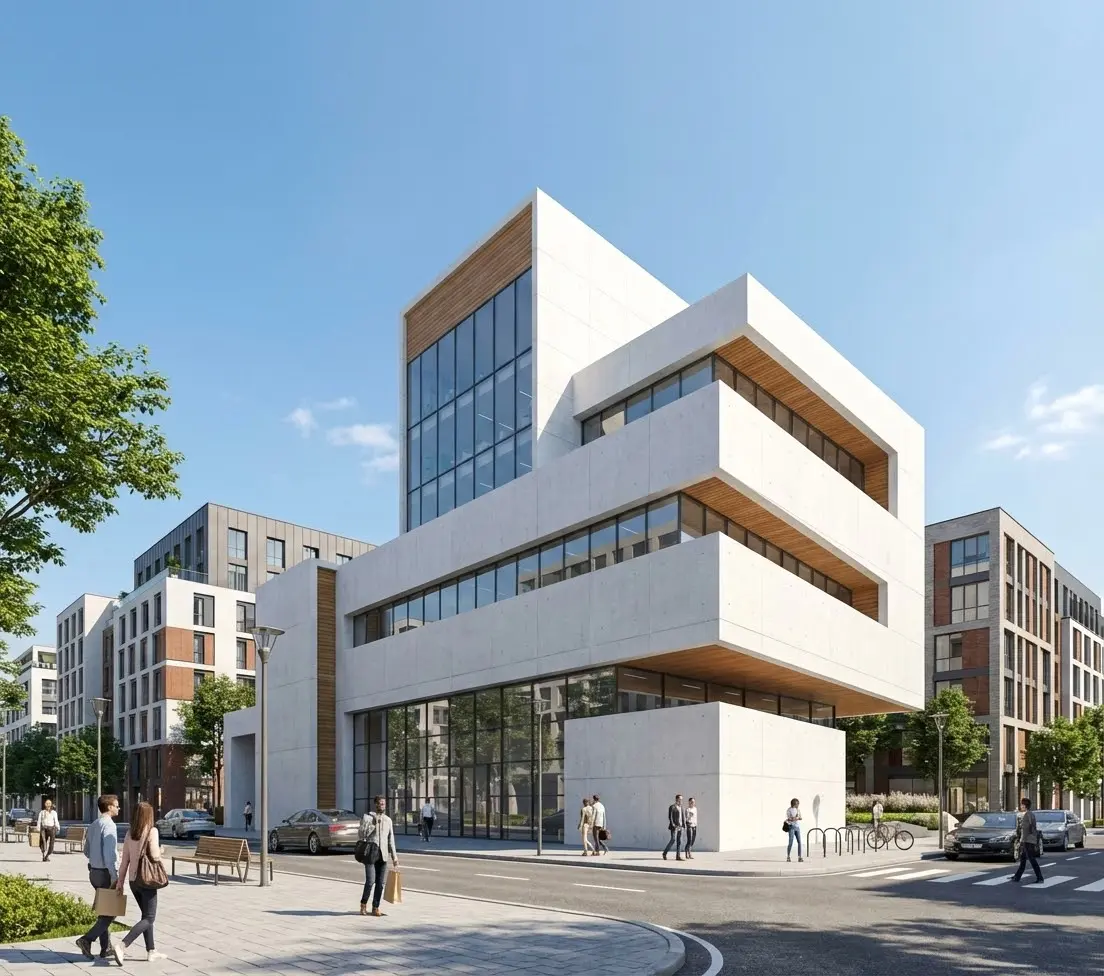

AI-generated architectural renders created with Rendershop in seconds
Rendershop: Bridging the Gap for Every Architect
The statistics show that while architects want to use AI, they need tools that are intuitive, reliable, and integrated into their existing workflows. This is where platforms like Rendershop are changing the game.
By focusing on the most time-consuming part of the design process — visualization — Rendershop allows architects to bypass the traditional "Adoption Gap."
- From CAD to cinematic in seconds: Rendershop's Render tool lets architects upload an image of a 3D model, hand sketch, or CAD PDF and transform them into photorealistic visualizations instantly — preserving the architect's original intent while leveraging AI's speed.
- Selective editing and retexturing: With Edit and Staging tools, architects can selectively retexture surfaces or virtually furnish spaces with a few clicks. This addresses the "Black Box" concern by giving the architect final control over every detail.
- Enhancing realism and resolution: The Enhance tool uses advanced upscaling and lighting algorithms to make AI-assisted renders indistinguishable from photographs, ensuring output meets professional standards.
- Video walkthroughs: Turn any render into a cinematic walkthrough video for client presentations — a capability that traditional rendering pipelines take days to produce.
The Future: From Draftsman to Curator
As we look toward the rest of 2026, the role of the architect is fundamentally shifting. Yale School of Architecture expert Phillip Bernstein suggests that AI will move the profession away from "drawing" and toward "specifying."
In this new era, the architect becomes a curator of possibilities. Instead of spending forty hours modeling a staircase, the architect will use AI to generate fifty variations based on specific constraints — cost, material, safety, and aesthetics — and then use their expertise to select and refine the best option.
"AI can accelerate decision-making, but it cannot define values, aesthetics, or vision. The firms that succeed will be those that balance the speed of the machine with the soul of the designer."
Conclusion: Don't Get Left Behind
The data is clear: AI adoption in architecture is no longer a question of "if," but "how fast." While the AIA reports a conservative 6% regular use in the US, the global trend — led by the UK's 59% adoption rate — points toward a future where AI is as ubiquitous as the mouse and keyboard.
For the modern architect, the goal isn't to be replaced by AI, but to be augmented by it. Tools like Rendershop are making this transition possible today, providing the speed of AI with the precision that professional architecture demands.
Whether you are part of the 6% already leading the charge or the 78% looking to learn, the time to integrate AI into your workflow is now. The buildings of tomorrow are being designed today — and they are being designed with AI.
Sources & Further Reading
- AIA (2025): Only six per cent of architects regularly using AI says AIA study. Dezeen
- RIBA (2025): RIBA AI Report 2025: Artificial Intelligence in Practice. RIBA Journal
- Chaos Group (2025): The State of AI in Architecture: Insights from 1,200+ Architects. Chaos Blog
- Archinect (2025): What 2025 told us about the future of AI in architecture. Archinect
- NVIDIA/ZHA Case Study: Zaha Hadid Architects with Omniverse and USD. NVIDIA
- Yale News (2025): How might AI affect architects? A Yale expert weighs in. Yale University
Join the AI Revolution in Architecture
Whether you're part of the 6% or just getting started, Rendershop makes AI rendering accessible to every architect. Get 50 free credits — no credit card required.
— The Rendershop Team